
Erskine Stewart talks us through a strong first year for the new platform and why workflow is the focus for the company’s next open house (22nd and 23rd April in Bracknell)
swissQprint launched Generation 5 in January last year, but as Erskine was quick to point out, nothing stays still for long. “As with everything we do, there’s always an evolution to every generation. Later in 2025, we introduced Topi 5 and Oryx 5, which are very important additions to the range. They’ve created a new entry point for businesses who have the output demand to enter into the swissQprint family at the right price.”
A strong first year in the field
So how has the UK market responded? Erskine says the reception has been extremely positive, with existing customers benefiting from new productivity gains compared to their older machines and new customers finding the platform opens up fresh applications.
He pointed to Ainsley Signs as an example. “They’ve now expanded beyond their core markets into retail work. The Generation 5 machine gave them one platform that can print on rigid material as well as roll-to-roll, and the quality from the Q1280i heads means they can enter more value-added work. That’s where the retail market is headed, and the versatility of the swissQprint platform puts businesses in a good position to follow it.”
The 10-channel ink configuration is a big part of that flexibility. The additional channel beyond the nine available in previous generations allows businesses to configure their machines with the right ink chemistries and colour sets for their specific applications.
Existing customers leading the charge
One statistic stood out. Last year was the first time swissQprint UK sold more machines to existing customers than to new ones. “They’ve either traded in a system and bought the Gen 5 to replace that, or they’ve added a Gen 5 platform to complement what they’re already doing,” Erskine said.
That says a lot about how much confidence the installed base has in the brand. And it feeds into something else I noticed during my visit. Erskine gave me a quick tour of the parts and ink store, and for a company with close to 150 machines in the UK market, the spare parts area is remarkably compact.
He explained, “Great engineering, great design. The team in Switzerland are incredibly thoughtful about everything that we do. We’re building for reliability. Part of that comes from enabling the design to be as modular and consistent as possible.”
For example, the bearings swissQprint introduced many years ago are still the best option. The ink pumps are the same across generations. A headboard from a Gen 1 machine can go into a Gen 4 with minor firmware updates. So while the capabilities of each generation have changed dramatically, a lot of the underlying engineering is about steady, incremental improvement with proven components.
Keeping the ink flowing
One of the things that came up during the tour was ink management, and specifically white ink, which is notoriously troublesome across the wide format sector. Erskine said, “There are preconceptions about what life with a large format printer is like. White is always a problem. For us, that’s not the case.”
swissQprint uses an ink recirculation process that pumps ink continuously to the printhead and back, even when the machine is switched off. You can hear it ticking over. Combined with what Erskine described as strong chemistry from their ink partners in terms of pigment dispersion, it keeps whites consistent and reliable.
The refurbishment programme
Refurbished machines are part of a growing programme that offers another route into swissQprint ownership. When existing customers trade up, swissQprint UK brings the old machine back in and goes to work on it. They replace heads where needed, tidy or replace the table, update panels, and bring the IPC up to Windows 11.
“We apply a 12 month warranty on the machine and people can expect the same reliability, versatility and performance as on any of our new machines,” Erskine explained.
It’s a smart move. The refurbished machines make the brand accessible to businesses that wouldn’t otherwise be ready to invest at new machine prices, and the feedback has been very positive. “It’s nice to see a machine which has had a good life, when well looked after, now make another business successful and profitable,” he reflected.
Where does Topi fit?
The Topi 5 is the other new entry point. It sits within the 3.2-metre bed-width group alongside the Nyala and Kudu, effectively a younger sibling with fewer printheads and roughly half the speed of the Nyala. Crucially, it still has the same 10 channels, the same build quality, and the same reliability.
When customers come to Bracknell for a demonstration, swissQprint simply runs the Nyala with one row of printheads switched off to replicate Topi output speeds and quality. Otherwise, you’re looking at virtually the same machine.
“Both the Oryx 5 and the Topi 5 are a compelling solution for many of our existing customers who have come with us from Generation 1 and are looking to upgrade,” Erskine says. “And it’s been well received by businesses considering alternative systems where they don’t quite need the Nyala’s full output capabilities, but where the Topi speed matches what they need.”
A network effect amongst owners
Something Erskine mentioned that I found particularly interesting is the informal network that has developed amongst swissQprint owners. If a UK business needs a job printed in Italy, swissQprint can connect them with an Italian owner who can fulfil that work on the same platform. The same applies in New York or California.
Closer to home, it works on a capability basis too. “Where a business may have varnish and another one doesn’t, they outsource that work to the company with varnish, or with neons. There’s quite a nice family environment where our swissQprint owners are supporting each other in different ways.”
It’s not a formal community on any particular platform. It’s built on the back of a sales team that knows its customers well and understands who to connect with whom. “We know our customers intimately in what they do, and we know who to connect with the right people,” Erskine adds.
New samples to show off the range
swissQprint has always put serious effort into its sample sets, and a brand new collection was launched on 1 April in time for the Open House event. Erskine is visibly proud of them. “We’re probably one of the only OEMs who has a regular model that we bring in. We are very thoughtful about all of the unique imagery we want to show.”

There are little touches of Swissness hidden in every image. Jewellery featuring the Edelweiss flower. A tiny Swiss flag tucked into the lettering. It’s subtle and nicely done.
The samples cover varnish effects showing gloss, semi-gloss and matte from a single varnish channel. There’s pyramid printing, a technique swissQprint developed over the last year that produces striking colour shift effects from a single image using neon inks or standard process colours. Metallic samples show how process colours and varnish on interesting materials can create effects like gold. And the chameleon effect demonstrates dramatic colour shift on both rigid substrates and, in a newer development, transparent film for window graphics.
The tiny lettering sample is one of Erskine’s favourites. Process colour text down to two point, white down to four point, including knockout text with a story about how the machine achieves it, hidden in the copy.
Production speed samples are there too, showing output at different print modes up to 341 square metres an hour. “When we talk about print speeds, they’re not just marketing speeds. They’re things that you can print images with and see the output yourself.”
All of the sample files are available for customers to download from the swissQprint extranet, along with tips on how to print them. It means their own sales teams can reproduce the samples and use them with their customers.
Open House with a workflow focus
swissQprint UK has an Open House event coming up at the Bracknell offices, and this year the format is deliberately different. Rather than a structured day with set presentations, they’ve gone for a traditional open house where visitors can arrive at any point, walk around, and speak to the various partners on show.
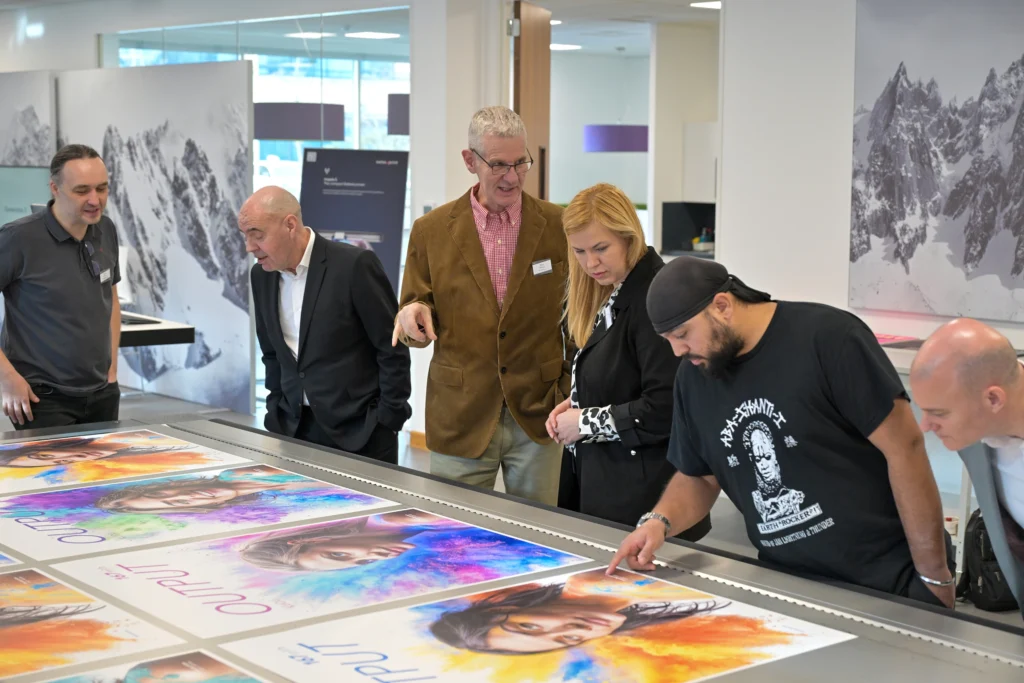
The focus this time is workflow automation. swissQprint has partnered with PrintIQ, OneVision and Caldera to show their solutions alongside the Generation 5 machines. “Businesses are often asking us how they operate more efficiently in a world where skilled individuals are harder to find. And how do they remove some of those obstacles for efficient production? We are looking to answer some of these questions at the event,” said Erkine.
Beyond the workflow software, the open house will demonstrate high speed production on eight by four sheets, FSDU production, embellished packaging, and a range of other applications designed to show what one platform can do for different types of business. If you’re a sign company wondering what else you could offer your customers, or a retail graphics operation looking to diversify, this is the kind of event where those conversations happen.
Erskine is also keen for visitors to see the local support infrastructure. Parts, ink and consumables stocked on site with at least three months of supply. A local service and technical team. Application experts who can help businesses get more from their machines. “We really are a local support partner,” he said.
What’s next
Beyond the open house, swissQprint UK will be at FESPA and is also exhibiting at The Print Show later in the year, taking a Kudu along with the latest samples and applications.
It’s been a strong 12 months. The Generation 5 range has landed well, the Topi 5 and Oryx 5 have opened up new entry points, the refurbishment programme is giving more businesses access to the platform, and the UK operation sits high in the global swissQprint rankings.
Erskine Stewart concluded, “For so many of our customers, our printers are generating high revenues for their business. If that printer is not running, then their business takes a big hit. We take that responsibility very seriously. We are looking forward to showing people what our printers are capable at the Open House and at the exhibitions.”
To register for the Open House event in Bracknell on 22nd and 23rd April, visit https://www.swissqprint.com/uk/en/news/events/uk-open-house-2026/