
John Mark becomes the first UK printer to install the Epson Monna Lisa ML-13000, expanding from wallcoverings into digital textiles.
Demand for matching wallpaper and furnishing fabric collections has prompted John Mark to branch into digital textile production, making the Lancashire company the first in the UK to install the Epson Monna Lisa ML-13000. Established for 14 years as a bespoke trade printer for international decor brands and boutique designers, the business has historically focused on wallcoverings, but frequent client requests for coordinating fabrics led the team to look for an in-house textile solution.
While many of the firm’s clients sell higher volumes of fabric than wallpaper, the multi-step complexity of traditional textile finishing had previously held the business back from investing. Conventional systems typically require separate machinery lines and chemical baths for pre-treatment, steaming, washing, and post-finishing.
Founder John Mark explained, “Whenever I looked into fabric printers, I saw all the separate equipment and processes needed for pre-treatment, printing, post-treatment and finishing. The investment and complexity were far greater than we could take on. There was no machine that gave us the straightforward workflow we were looking for.”
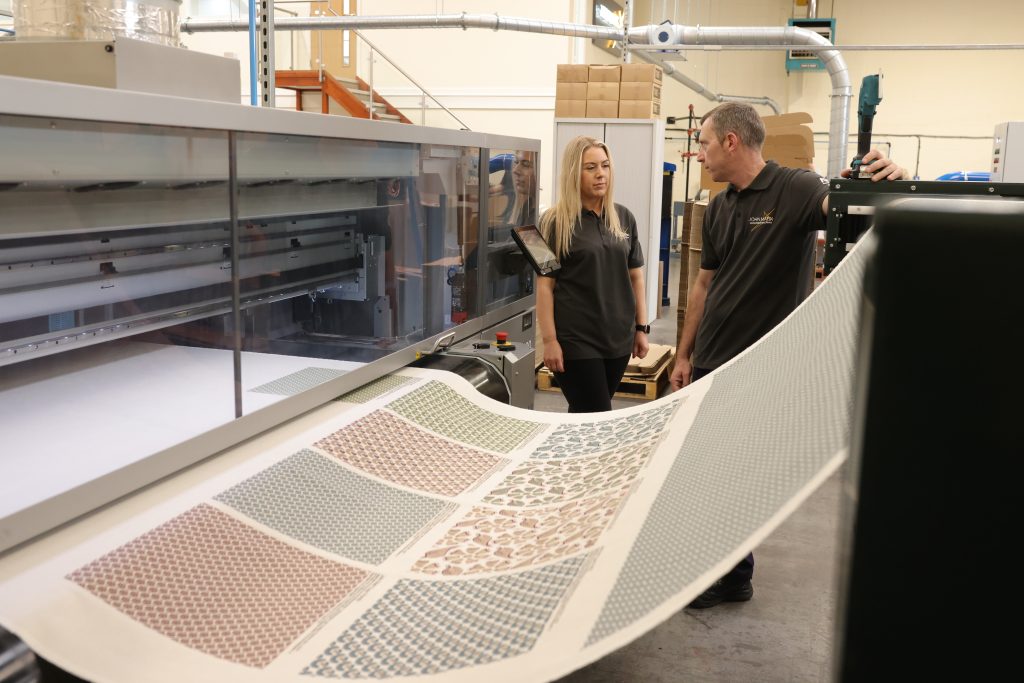
The breakthrough came during a demonstration of the direct-to-fabric Monna Lisa ML-13000 at Epson’s European facility. Built with an inline fluid system, the machine applies pre-treatment, pigment inks, and post-treatment chemistry directly onto the cloth in a single pass. Because chemical treatments are jetted only where ink is deposited, unprinted areas retain the natural soft handle of the raw substrate, avoiding the overall stiffness often found with immersion coating methods.
Mark added, “It did everything in one, which was exactly what we wanted. The print quality, depth and strength of colour were impressive. We had looked at the market over many years, but this was the first solution that made entering textiles work for our business.”
Installed at the company’s Leyland facility alongside an inline electric curing oven, the system underwent three to four months of testing before taking on live work. To ensure colour consistency across complementary wallpaper and fabric lines, John Mark profiles each cloth using an X-rite i1Pro 3 spectrophotometer and its established Ava workflow. The setup recently allowed the team to reproduce and convert more than 200 colourways for interior clients left without a supplier following the closure of an independent mill.
With production now fulfilling commercial orders, John Mark is already evaluating the installation of a second ML-13000 to manage future demand. Mark concluded, “We don’t regret our decision to choose Epson. The machine has lived up to our expectations and certainly does the job. We now feel confident that the team, materials and processes are ready, and we can really take this offer to the market.”