
As well as marking a momentous 40-year milestone, Signbox recently announced its acquisition by Stewart Signs. Jack sat down with Signbox MD Mark Bartlett to discuss the history of the company, the strategic timing of the deal, and the exciting future for the combined businesses.
Finding the right fit
Mark admitted that after four decades in business, the idea of an exit strategy began to take shape. Having resisted some initial interest, the crucial factor was finding the right fit, not just the right price.
“You don’t usually go into business just thinking about selling it. You start a business because it’s something you enjoy and are passionate about. At least I certainly did,” Mark explained.
The right partner arrived in the form of Stewart Signs, with discussions starting about a year ago. The resulting agreement is an earn out basis deal, providing Mark and his co-founder Matthew [Wilkins] with a comfortable timeline for retirement, whilst for now, very much remaining at the helm.
“We were very comfortable with the deal as it stood and we then started exploring the synergies, of which there were many. Stewart Signs has six decades of history, Signbox has four decades of history. Put those together and it’s a fantastic legacy,” adds Mark.
Ruby Anniversary
The Signbox story began 40 years ago in 1985, springing from a youthful conversation between Mark and Matthew, who both worked for 3M in Bracknell at the time.
“There’s a famous adage that the best 3M customer is actually an ex-3M employee,” Mark jokes.
Mark and Matthew started their careers in the very early days of the CAD-CAM era in the UK, at a time when vehicle graphics were still largely sign-written. Backed by the small firms’ loan guarantee scheme, they founded Signbox.
An important milestone came when Mark, who trained initially as an architect, recognised the growing opportunity in architectural signage. Following a chance exhibition stand next to ShopKit Designs, they saw a way to apply their vinyl-cutting expertise to interior displays. This led to the development of SignKit, a joint venture for fixings that successfully saw them specified by architects for wayfinding and branding projects.
Investment in technology followed, from routers and lasers to their first solvent printer, before moving into specialist print for commercial fit-outs, principally in London. Key to their growth was their investment in Durst printing technology to handle the growing demand for glazing manifestation and environmental graphics.
“It meant we could print white onto optically clear manifestation film. And that really snowballed our investment in print technology,” Mark recalls.
Architectural heritage meets fleet expertise
The acquisition makes perfect sense when considering the companies’ heritage. Stewart Signs is a long-standing 3M platinum partner, heavily invested in fleet, rail, and transport markets, effectively, back to Signbox’s original roots.
Mark sees the deal as an exciting opportunity to go back to that heritage. Stewart Signs, in turn, gains a massive advantage through Signbox’s architectural specialism.
“They see this as a strategic acquisition, in being able to offer hard signage to all of their clients,” Mark adds.
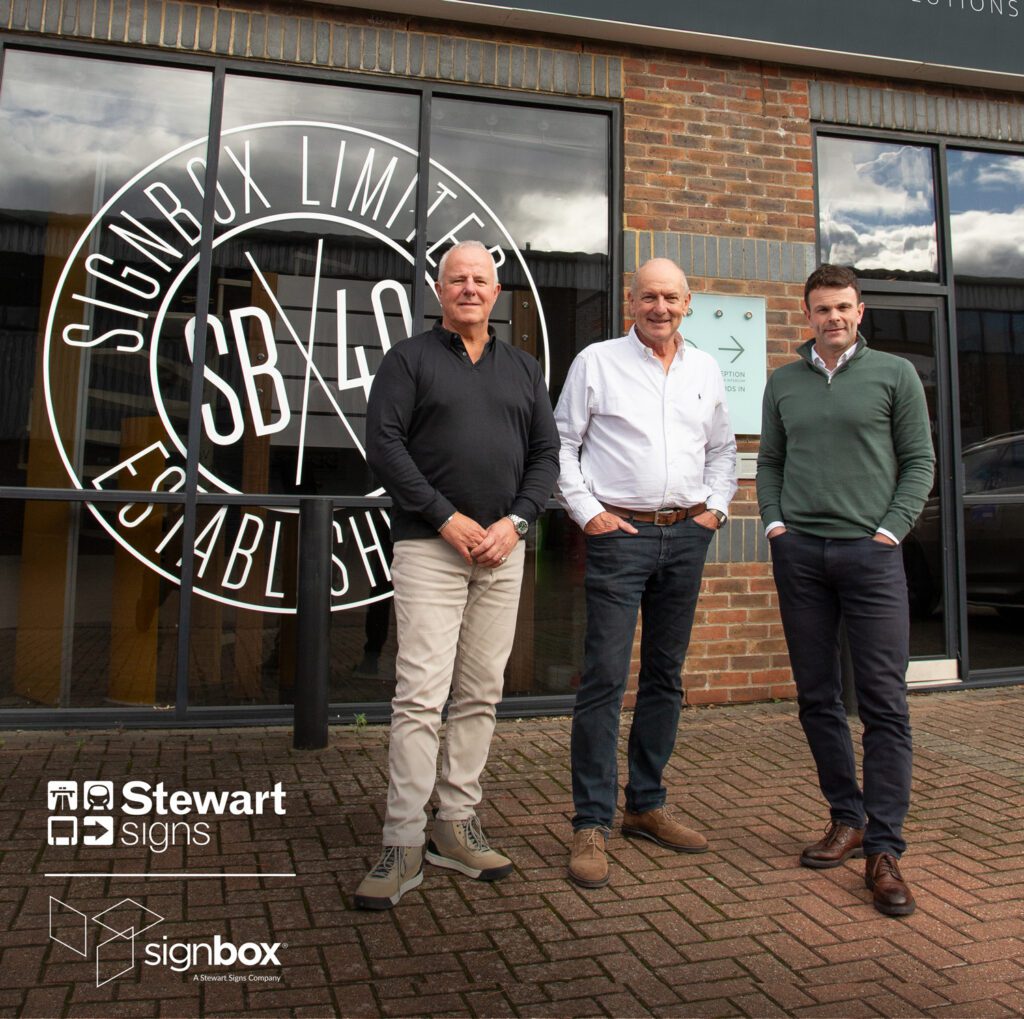
Another major area of growth for the combined group is digital signage, where Mark confirmed this is a strong area for joint expansion alongside Signbox’s own very successful digital brand (www.digitalsignbox.co.uk).
Crucially, the culture and values of the two companies were found to be very similar, ensuring a smooth transition for the teams. This partnership provides Signbox with the strength to tackle larger, more ambitious projects.
“The strapline ‘Two iconic brands, one bold future’ sums it up very nicely,” Mark says.
The Importance of the BSGA
Mark’s final reflection on the company’s legacy touched upon its long membership of the British Sign and Graphics Association (BSGA). His initial motivation to join was prompted by several industry competitor safety issues, which highlighted the need to have a full understanding of the British Standards in sign manufacture.”
“It led us to the BSGA and the code of practice that the BSGA is so good for,” Mark explains.
The association has provided crucial support over the years, from advising on the engineering of high-level signs—such as a 60-metre-high skyline sign in Canary Wharf—to solving technical issues, like the issue of interior paints repelling vinyl adhesive. For Mark, the BSGA provides the necessary compliance and support to deliver safe, quality products in a heavily competitive, price-driven market.
The acquisition by Stewart Signs cements the legacy of Signbox. Having built strong brand equity over 40 years, the partnership provides the stability and resources for growth, while retaining the Signbox brand and culture. For Mark, it’s a positive passing of the torch, allowing him to step back gradually (but definitely not for a while!), knowing the company is with a partner who will take that legacy on and just grow it.