
ZCZH’s system prints investment casting wax patterns directly from 3D data, taking the mould tooling stage out of precision casting workflows.
ZCZH has built its new wax jetting system around Xaar Nitrox printheads. The China-based industrial 3D printing company uses them to produce investment casting wax patterns digitally, and Xaar says the approach helps manufacturers cut lead times, improve accuracy and work more flexibly.

Wax patterns are a critical stage in investment casting. They feed directly into dimensional accuracy, surface quality and overall production efficiency. Traditional methods rely on manual engraving and mould-based tooling, so they take time and cost money to modify. They also suit neither small batches nor highly complex parts. As a result, as competition in precision casting tightens, manufacturers are looking harder at digital alternatives.
Why the Xaar Nitrox printheads suit wax
ZCZH’s system replaces that conventional workflow with a fully digital additive process. Inkjet deposition sits at the core of it. The Xaar Nitrox printheads work alongside the company’s TF Technology and Sure Flow fluid management system. Together these enable continuous ink recirculation directly behind the nozzles. That prevents sedimentation and reduces the risk of clogging, which matters a great deal with a fluid like wax. Xaar says the printhead architecture also supports stable jetting of higher viscosity fluids while holding precise droplet control, so wax deposition stays consistent across complex geometries.
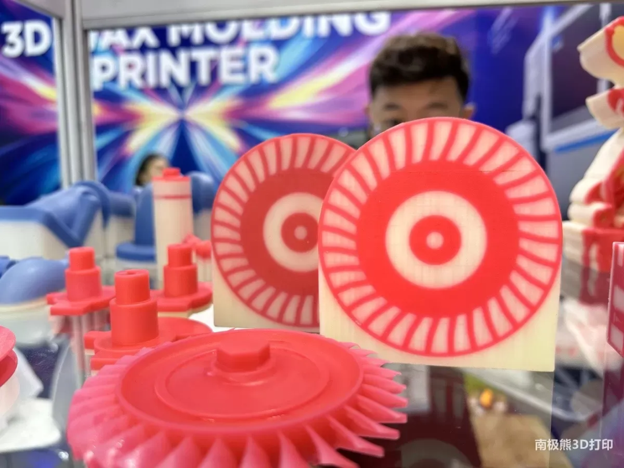
Because the patterns come straight from 3D design data, the system needs very little post-processing. Production cycles then compress from days to hours while maintaining micron-level accuracy and repeatability. In turn, foundries get a quicker route through new product development, first-article verification and small-batch production.
Taking the tooling out
Handling higher viscosity materials matters in wax jetting. Fluid behaviour feeds directly into feature resolution, surface finish and structural integrity. Xaar puts that capability down to its printhead architecture and Ultra High Viscosity Technology. Alongside that, controlled temperature management supports throughput and repeatability in production environments.
Samual Tam, General Manager at Xaar Asia, says, “Wax pattern production places very specific demands on accuracy, repeatability and production stability. This project demonstrates how industrial inkjet can be used as a reliable manufacturing process rather than a prototyping tool. By combining precise droplet control with stable, long-duration jetting, inkjet enables manufacturers to digitise complex workflows and achieve consistent results at industrial scale.”
The system supports small-batch and multi-variant production, so design changes can be made at the digital model stage without any tooling. That removes mould costs. It also makes complex, low-volume components more viable commercially, particularly in aerospace, automotive, medical devices and industrial equipment manufacturing.
The project points to industrial inkjet moving further into manufacturing beyond conventional print markets. By driving wax pattern production directly from digital data, the Xaar Nitrox printheads are helping ZCZH offer precision casting manufacturers a practical route to digitising a stage that has stayed stubbornly manual.
Find your next supplier in The Guide