
Tradeprint, Antalis, Reconomy, FESPA UK and IPIA come together to inspire an industry-wide commitment to large format banner recycling
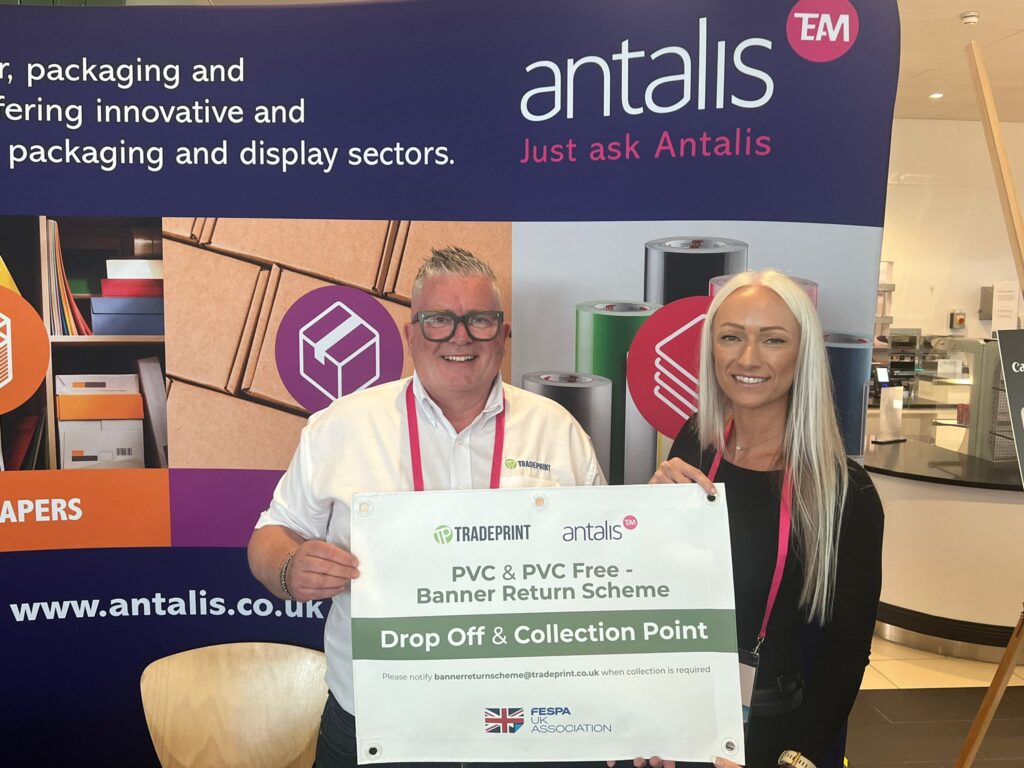
A new initiative that allows companies to return printed banners for recycling has been launched by Tradeprint in partnership with Antalis. The pilot scheme will see five Antalis sites available for Tradeprint customers to return banners, not only free of charge but also with further incentives to purchase PVC-free materials in future.
The strategic imperative for material change
The main reason for the return scheme was an operational decision by Tradeprint to move away from traditional PVC, a material that poses significant disposal issues at end-of-life. PVC has traditionally been popular in the industry because of its low cost and durability, but it is widely regarded as environmentally damaging because it contains chlorine and toxic plasticisers such as phthalates. Furthermore, PVC is notoriously difficult to recycle and is often banned from incineration because of the release of highly toxic dioxins.
Anthony Rowell, Sales and Customer Success Director and Sustainability Lead at Tradeprint, says, “PVC was identified as one of the main challenges in removing problematic plastics from the supply chain. Our response was to launch a global campaign, internally codenamed Project Hulk due to its scale and environmental focus (it’s big and it’s green!), to secure a high-performance PVC-free alternative.”
The new PVC-free materials have seen early success, with customer uptake increasing. “23% of banner orders now placed with Tradeprint are for the PVC-free option. This is up from less than 10% previously,” confirms Anthony.
Watch the full interview with Anthony and Katie below…
Built for circularity
The search for an alternative material involved both international and UK-based suppliers. Tradeprint needed a substrate that could meet and compete favourably with the quality and durability standards set by PVC, ensuring customer confidence in the switch.
“We now have PVC-free materials that have been rigorously tested against twelve criteria, including resistance to folding, packing, and even high-pressure cleaning. The result was the adoption of materials that are not only equal to PVC but also stronger, slightly thinner, and offer better print resolution. It’s a huge step forward in our objective of removing PVC from our shelves.”
Finishing is often as important as printing, so Tradeprint has also moved to using only polycarbonate grommets with the banner material. “This aids recycling because, while PVC is difficult to process, the new PVC-free substrate is a monomeric (single) material, making it significantly easier to recycle than layered materials. The new grommets help provide a more holistic approach to the product’s end-of-life cycle,” adds Anthony.
The logistics of the banner return loop
The banner return scheme was ultimately designed as the most effective way to educate customers about the superior benefits of the new PVC-free product and to ensure its responsible disposal.
Anthony Rowell explains the rationale behind the programme, “The new PVC-free material is a great product and is available at a slightly cheaper price point due to the way we sourced it. Now, it is all about educating the customer so they know why we’ve done it and what the benefits are to them. After much discussion, we decided the best way to do that would be to offer a free return scheme at the end of the life of our banner products, in exchange for a discount code for a PVC-free product.”
He adds, “For me, this is all about inspiring other businesses to take a positive step and consider how they could offer a return scheme for materials. We want all products to be recycled efficiently and safely, not just ours.”
The project required strategic collaboration to manage the logistical complexity, particularly regarding waste legislation and site health and safety. Tradeprint’s partner of choice, Antalis, stepped in to provide the essential infrastructure.
Katie Farr, Marketing and Communications Manager at Antalis, explained that their role is to act as the waste storage partner, utilising five of their UK sites; Coalville in Leicester, Dartford, Leeds, Northampton, and Coventry. These sites, along with Tradeprint’s Dundee premises, provide accessible drop-off points for Tradeprint customers to dispose of their waste.
Katie Farr explains, “When Anthony first approached me with the idea, it was about ensuring that we could provide safe, easy access for Tradeprint customers to make the drops and store the waste securely. But being part of the initiative and what it stands for was never in question. That’s something we’re very passionate about. The site managers, in particular, are especially supportive and passionate about being part of the scheme and look forward to contributing to the benefits of the programme.”
Antalis’s involvement was vital because of its existing relationship with waste management specialist Reconomy. Anthony says, “It’s quite a complex scheme, so we need a partner who’s got places in the country that will receive the used banners and handle them properly. Antalis and Tradeprint share a relationship with Reconomy, and that makes it easier to collect the banners and send them to the recycling site in Manchester.”
Customer engagement and behavioural change
Tradeprint conducted a comprehensive survey that indicated positive initial customer feedback. Anthony created a heat map of customer locations to strategically align the pilot Antalis sites with potential return points, optimising collection feasibility. While the initial plan depends on customers physically gathering to drop off materials, the ultimate goal is to expand the project to include an enclosed return label for collections, depending on the success of the pilot.
Anthony simply defines success for the pilot. “If even one banner is returned, I’ll be happy. More seriously, we conservatively expect a 10% to 12% return rate, which would provide enough data to adapt and scale the scheme.”
Inspiring the industry
The significance of the banner return initiative extends beyond Tradeprint’s operational footprint. Both Tradeprint and Antalis, as IPIA council members, view the scheme as a model for the wider industry.
Katie adds, “Antalis is very much aware of the significant environmental challenge posed by large format printing and visual communication waste. Banners commonly used in event and marketing communications often end up in landfill, contributing to the waste management issue. This project aims to reduce the amount of product and material going to landfill by partnering with like-minded organisations and waste management experts.”
The returned material, now PVC-free, will be shredded into plastic pellets and given a second life, repurposed into products such as road cones and plant pots.
A key aim of this project is to foster a culture of recyclability and sustainability across the industry. Katie concludes, “We are demonstrating that through partnership, companies can establish practical and scalable solutions for responsible resource management, thereby inspiring other businesses to take similar positive steps. The scheme represents a crucial first step in formalising a recycling stream for a product category that has long struggled with sustainable end-of-life solutions.”
For more information please check out the Tradeprint website https://www.tradeprint.co.uk/additional-services/banner-return-scheme and their blog https://blog.tradeprint.co.uk/tradeprints-banner-return-scheme-driving-a-circular-economy-in-print
If you’d like to learn more about the scheme please contact Anthony Rowell, arowell@tradeprint.co.uk